
Welding automation
Welding automation built for real fabricators
Deploy a cobot welder in hours. No programming, no robotics expertise. Consistent, high-quality welds from day one.
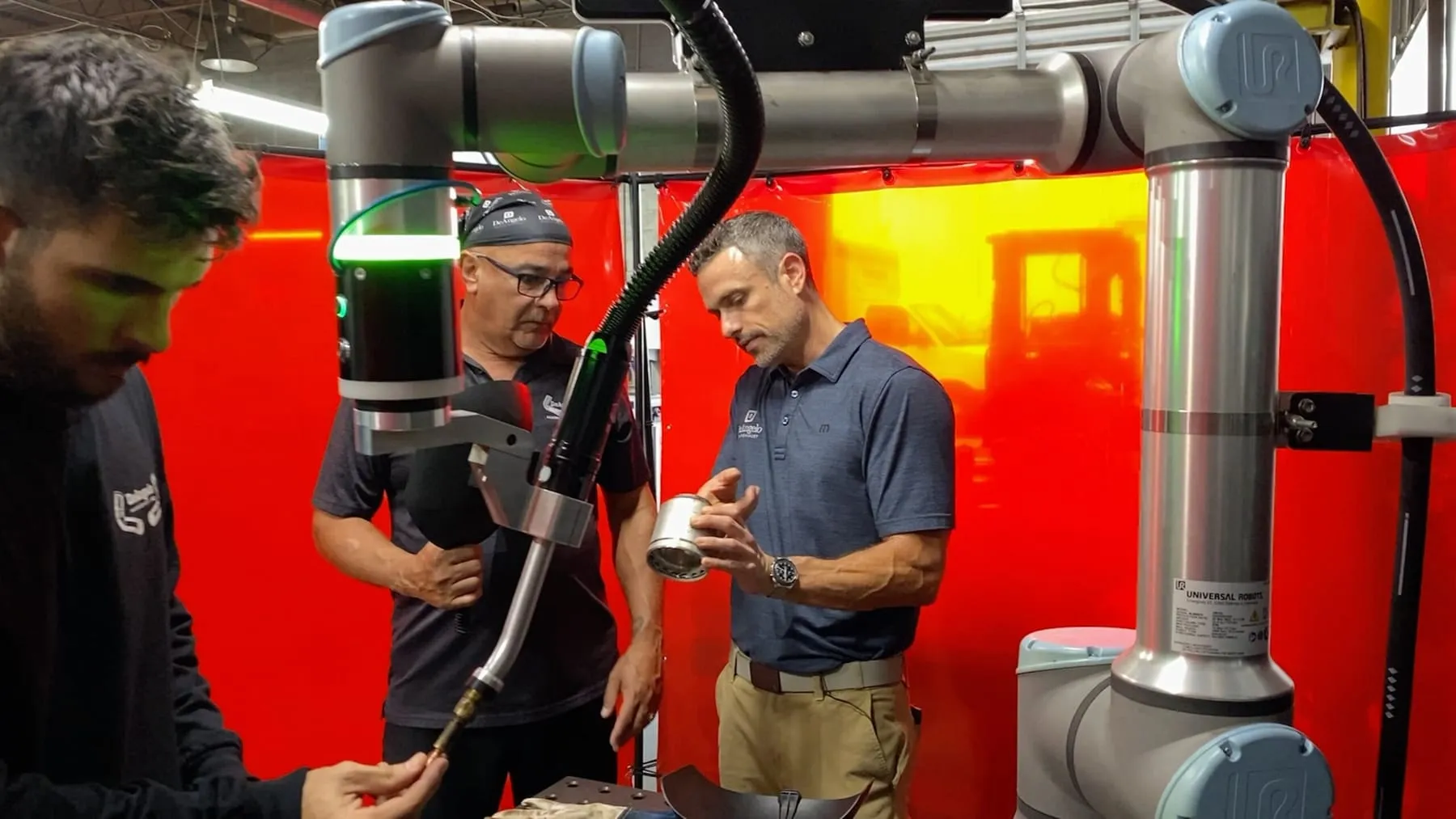 PRODUCTION FLOOR
Is this right for you?
Automation that fits your shop, not the other way around
Most welding automation is designed for high-volume lines with dedicated robotics teams. That doesn't match reality for most fabrication shops, where jobs change daily and nobody on staff speaks robot.
You can't find enough welders
The skilled labor shortage isn't going away. Your best welder teaches the cobot, and it runs the same quality weld every time. You get more work from the team you have.
Your jobs change constantly
Traditional robotic cells are optimized for one part, forever. This system is built for shops running 5, 10, or 50 different parts a week. Changeover takes minutes.
You've been burned by automation
Maybe you bought a system that sat in the corner because nobody could program it. If your team can use a smartphone, they can run this.
You need to quote sharper
Lower labor cost per part without sacrificing quality, and win bids you'd normally pass on.
Compare your options
Choose the right welding automation for your team
The biggest differences come down to time-to-production and total cost of ownership.
DIY cobot build
Seems flexible, but hidden costs, slow deployment, and outside expertise add up.
- Long customization process
- Requires in-house resources
- Months of trial and error
Our cobot systems
OURSA proven, app-based platform: fast, easy, and scalable for any team.
- App-based, no-code control
- Proven, standardized design
- Welding production parts in hours
Custom integrator cell
Specialized, but expensive, slow, and tied to rigid programming phases.
- Often $200K+ before the first part
- Longer timelines
- Complex programming
How it works
Production-ready welding automation in hours
01
Schedule a demo
Walk through your specific parts and applications with a Beacon specialist. See exactly how the system handles your work.
02
Get set up
Your cobot welder arrives pre-mounted, pre-wired, and ready to weld. No third-party integrators, no waiting weeks.
03
Teach paths and deploy
Teach weld paths by physically guiding the cobot with the Smart Puck. Save parts and deploy them in minutes, with no coding.
04
Track and optimize
Beacon's analytics show arc-on time, cycle counts, and quality metrics, so you can spot bottlenecks and raise throughput.
 IRON SUPPORTS — OUTPUT ×5
Backlog cleared in weeks
“We had it welding parts in about four hours. My guys can use it, and none of them are programmers. That's the whole point.”
Questions
Welding automation: common questions
Is welding automation worth it for small shops?
Absolutely. Welding automation used to require six-figure custom integrations that only made sense for high-volume production. Cobot welders changed that equation. Shops running as few as 2–3 welders see meaningful ROI through increased throughput and reduced labor dependency. The system is specifically designed for high-mix, low-volume work, the kind most small and mid-sized fabricators handle every day.
How is a cobot welder different from a traditional robotic welding cell?
Traditional robotic welding cells are large, expensive, and require dedicated programming expertise. They're optimized for running thousands of identical parts. A cobot welder is collaborative: it works alongside your team, requires no safety caging in many applications, and is programmed through an app instead of a teach pendant or offline software. That makes it ideal for shops that switch between parts frequently.
How much does welding automation cost?
Cobot Welder packages start at $105,000, which includes the collaborative robot, welding power source, torch, table, and Beacon software. Custom-integrated robotic welding cells typically start at $150,000–$250,000+ before programming and installation costs, so the total cost of ownership is significantly lower.
Do my welders need robotics experience to use a cobot?
No. The Beacon app is designed so that anyone who can use a smartphone can program and operate the cobot welder. Your experienced welders bring the welding knowledge (travel speed, wire feed, gas flow) and the app handles the robotics. Most teams are comfortable running production within their first day.
What types of welding can a cobot automate?
MIG welding (GMAW) out of the box, with TIG-quality results available through advanced MIG processes. The system handles carbon steel, stainless steel, and aluminum across a range of thicknesses. Fillet welds, butt joints, and complex multi-pass welds are all included.
How long does it take to set up a new welding job?
Most new parts can be programmed and running in under 30 minutes using the Beacon app's tap-to-teach interface. Repeat parts load from a saved program and are ready to weld in seconds. That fast changeover is what makes cobot welding practical for shops with high part variety.
Start
See it weld your parts
Bring your parts and your people to Nashville. We'll teach your team on a real system, and you judge the results.